Tuesday, 3 September 2013

Southern Colombia


Pineapples in this part of the world taste about ten times better from the ones I've tasted back home  
Having finally escaped Cali I was keen to make some progress south after my extended stay in the city. I left early morning as I wanted to try and push for Popayan which was a solid days cycle away. Unfortunately as the day progressed the less likely it looked like I was going to make my target as I was feeling more and more run down. This was more than just the usual struggle of a first days back on the bike after a long break, believe me I'm well familiar with what that's like after my various stopovers. This was more the run down kinda feeling you have when you are not firing on all cylinders. Perfect timing, feeling fine on my few weeks off in Cali and on my first day back on the bike I'm sick. By the time it was getting dark I was weighing up whether to put on the bike lights and struggle the last 20 or 30 km in the dark. Thankfully I decided to call it a day. I wasn't too optimistic about the first house I approached to ask to camp in their garden as it had a big fence around with two dogs barking at me. I didn't have any choice but to try as it was practically dark and there wasn't many options. Yet again, the family were extremely welcoming and not only did they agree to me staying but even offered me a bed in a spare room that they had. This was a first for Colombia and couldn't have come at a better time considering my run down state. I needed a good nights sleep and got one after they gave me a big feed!
The next day after several photos of their novel decorations I hit the road for the last stretch to Popayan. It was a struggle and I was cycling even slower than my usual relaxed pace.

The lovely family who invited me in and gave me a bed when I needed it, not to mention a great dinner.

Their novel wall decorations made up of lots and lots of cigarette packs

Beer bottle tops, a novel way to re-use them

Thankfully I was less than 5 km along the road when I bumped into the incredibly friendly Alvaro who was out for a Saturday spin. I apologised for my slow pace explaining that I was a bit under the weather. He didn't seem to mind and even invited me back to his house for lunch. I ended up staying with Avaro and his lovely family; wife Rubia, daughter Manuela and their uncle for a week! I was in no position to cycle for a few day and as luck would have it I was after stumbling across one of the kindest families in Popayan, not only that but Rubiela was a nurse who worked in the local hospital. Herself and Alvaro brought me into the hospital for a quick check. I had been staying in a house during my last week in Cali with a girl who was recovering from dengue fever. Thankfully I didn't end up having dengue and just needed plenty of rest.

Myself, Alvaro and some of Rubiela's family

Central Popayan with all of it's white buildings

Popayan

Alvaro testing out my mattress. Alvaro was one of the biggest (actually smallest) messers that I've ever met and kept me well entertained!
Adios amigos
Mountains getting bigger in southern Colombia


A week later I hit the road fully recovered thanks to the tremendous hospitality of the Muñoz family. I was slightly apprehensive as to what lay ahead of me for my last few hundred kilometres to the Ecuador border. This was because I had to try and pass "los Paros" which were the strikes and roadblocks that had been taking place in numerous parts of Colombia for the previous fortnight. They were the main thing on the Colombian news stations. I had been warned by Nicolas (the Argentinian Pan American cyclist) that they were not the most pleasant. The strikes were taking place in various areas of the country for different reasons ranging from miners rights, the low price of coffee and other foods, students and free trade agreements.

Not taking any chances with this police tank
Strong police presence on the road in southern Colombia
As I progressed along the increasingly quiet Pan American highway I did not really know what to expect. I passed a final police check point where there was no more traffic passing. The young police man asked me was I a gorilla after taking a photo of the police sign stating the road was closed. I clarified that despite not shaving for a few days that I was definitely not a gorilla but had occasionally been accused of being a monkey.. but never a gorilla. A few kilometers past the last police traffic cones at about ten in the morning I encountered my first "Paro" on the outskirts of Mojarras. There were about a hundred people including children with suitcases and bags sitting by the sides of the road. I made my way past them to an initial line of about eight young men with metre long sticks standing in a line blocking the road. They had most of their faces covered with clothes or the occasional balaclava. About 30 metres behind them was a larger group of about fifty or sixty men blocking the road. I introduced myself, told them what I was doing and asked them could I pass. They said nobody was getting through until 4 pm. Then I told a white lie, I said that I was cycling from Alaska to Argentina to try and get in the Guinness Book of records for the fastest time and therefore every hour and minute counted! Nicholas had managed to get through the week previous so I thought I'd try my luck, although another Argentinian cyclist heading north had taken a lot longer to pass and had been hit in the face by a rock at one of the blocks so I knew I had to thread carefully. Despite my supposed record breaking attempts they said that I would not be getting through until 4 pm. I wheeled my bike about 100 metres back from the front line and sat down by the side of the road resigned to the fact that I could write most of this day off in terms of cycling. This was my first roadblock and many more lay ahead.

No way through


As the morning progressed the two main Colombian television stations arrived along in their trucks and set up their large satellite dishs. Later on three white United Nations vehicles arrived along and some of them went up to the front and passed through on foot. I found out that one of the reasons that the UN was here was to oversee the release of two police officers who had been held captive by the protesters. Later on in the early afternoon to great fan fair two plain clothes police men were escorted through the mass of people blocking the road. By this stage of the day the crowd of protesters had swelled to a few hundred, still with sticks in hand and faces covered. The news stations didn't waste any time in interviewing the two police men. The interview went out on national television almost immediately. At this stage things got really interesting. Lots of the protesters had watched the interview in a nearby bar and didn't like what they heard. I am going on hear say but apparently one of the police men intimated that they were not treated well or that some of the protesters had FARC connections. The two policemen along with a few United Nations representatives were still conducting interviews when they were quickly surrounded by about a hundred protesters who had come across the line from the main group. They wanted to take the two police men back. This was all going on on the opposite side of a United Nations van from where I had parked my bike up which had been out of the way until a short time previous. What followed was about an hour of very intense negotiations between the relevant parties. At one stage a few of the protesters set some police uniforms and belongings on fire. Eventually it was agreed that the two police officers were free to go and suffice to say that the UN officials did not wait around and the three van tore off up the road with the police men with them.


The interview before chaos insued
Pouring petrol on the police mens clothes and belongings
.. and then they were set alight
As the afternoon progressed families with young children were being let through. One of the guys I had pleaded with to let me through earlier that morning and said that I should ask again. After a few minutes of back and forth it was agreed that I could pass accompanied by one of the protesters who at this stage had removed his face cover and seemed a lot less intimidating. I had a good chat with Miller who was the protester who accompanied me through the strike zone. He was probably in his early twenties and told me that around the town of Mojarras alone there were about 10,000 protesters. The barriers we passed included entire trees that had been cut down, the shell of a burnt out bus or truck, three individual metre wide by metre deep holes that had been hug into a bridge rendering it impassable in a vehicle. There was also lots of rocks and stones scattered on the road. We walked up through the town that had a kind of festive atmosphere to it and through to another road block about 15 mins walk from the first block on the opposite side of the town. I had initially wondered would it have been possible to cycle through a few fields and skirt around the road block but thankfully I hadn't done this as the entire town and surrounds were involved in the strike and blocks.

Miller, my escort through the police free striking town of Mujarras. As you can see vehicles could not pass. It was enough of a struggle with the two of us trying to lift my heavy bike over the tree!

Lots of various burnt out remains
Once through Mojarras the road was almost deserted. I was relieved to have my first protest behind me and was thrilled to be back cycling through some beautiful scenery with the road to myself. I wild camped by the side of a mountain that night for the first time in Colombia. The following day I passed about 4 more road blocks but was thankfully allowed to pass each one and there wasn't quite the same level of menace as at the first Paro. Once I made it as far as the city of Pasto I was informed that I should not have to pass any more strikes as they had been called off in the southern most provence of Narino. That was a relief as I must have later passed at least ten locations where there had clearly been recent road blocks with burn marks on the road, fallen trees and the road side crash barriers had been pushed roughly back into place.

A few beeps and thumbs up of encouragement from the passing convey from the red cross. Some of the very little traffic that passed. 
Obstacle course
First night wild camping in Colombia and the bugs ate me alive

Here a block, there a block

A deserted Pan American highway


Normally I time my border crossings to be in the morning or early afternoon but with all the uncertainty of the previous days strikes I was keen to get into Ecuador. At about 5.30 in the evening I crossed the border into Ecuador during a World Cup qualifier between Colombia and Ecuador. While I was getting my passport stamped on the Colombian side they scored a goal and the entire staff including security guards ran into a tiny office to see the goal. Ah the World Cup!

Ecuador line up for a penalty which they missed.
As I cycle south it is always interesting to observe the similarities and differences between the various countries. One thing I noticed that happened a lot in Colombia compared with Central America was that people give the thumbs up signal a lot. After a fantastic two months in this fascinating, diverse and colourful country Colombia gets two big thumbs up from me.

The fantastic extended Espana family where I stayed on my last night in Colombia in Pasto.

Friday, 23 August 2013

Cali


Cali, what can I say about Cali?! I planned on staying about 3 days in Cali but ended up staying nearly 3 weeks. Too many distractions; The World Games, The International Salsa Festival, pretty girls and some great bakeries to name but a few. The last few weeks of my journey could be more accurately described as Billy’s Big Salsa Class and obviously no better place to do a class or 12 than Cali, the world salsa capital.
My arrival into Cali on a Thursday evening coincided with the last few days of the World Games which are the Olympic's little brother. I was in a rush to meet Andrea, a local Caleña who I had met through couchsurfing. We met downtown at about half past six and she gave me directions as to where to meet near her apartment while I cycled and she caught a taxi across town. While making my way to our meeting point with my packed bike I stopped to ask directions at a street corner. After a few questions along the lines of where I was from and what I was doing with all the gear on the bike I noticed that one of the guys had a large television camera. A few minutes later I was doing an interview on Colombian national television about my trip with a crowd of about thirty people around me taking photos. It's amazing who people will line up to have their photo taken with once there is a TV camera in front of them... I didn't even have my Trocaire t-shirt on?! There was a big cheer from the crowd when I waved a Colombian flag that had been thrust into my hands! In the middle of the interview I could feel my phone vibrating with Andrea ringing, worried as to where I had disappeared to! She quickly forgave me for my late show and was laughing as she over heard a passer by exclaiming that I was the cyclist from the television!
  

The World Games feature lots of sports that haven’t made it into the Olympics such as Tug of War, Lifesaving, Sumo, Latin dancing, Heavy Ball and Artistic Roller Skating to name a few. Once I heard it was not sold out and that some of the tickets were quite cheap I was very excited to go off and check out a few sports that I had never heard of twenty four hours previous. First up was Beach Handball in the city bullring. I got to see the local Colombian team get cheered on to beat Australia. Later that day it was off to see the rugby sevens which seemed to be a lot more popular and was being held in the main stadium - Estadio Olimpico Pascual Guerrero.

Colombia Vs Australia in the beach handball
Brazil Vs Hong Kong in the rugby sevens
The Colombia rugby team get great support from their home crowd
The following day I went to see kayak polo with Andrea and her boyfriend Egor. The outdoor Olympic pool was only a short walk from her apartment. Amused to see what kayak polo was all about, it actually did not take me long to become quite absorbed in the matches. When it comes to kayak polo the Germans appear to be a pretty difficult team to beat. They are very efficient at scoring goals.

France Vs Holland in the kayak polo

Taking a break from the kayak polo and the baking hot sun. No better way than with a cholado, a delicious, refreshing fruit, ice and syrup mix.
In the packed out, very warm gymnastics hall


Athletes in action on the floor
Thinking that was me done, Andrea and Egor kindly invited me to the gymnastics which was sold out. There was a fantastic atmosphere in the large arena. We later finished the day off with what I surprisingly found to be the most impressive of all the events witnessed, the climbing. Not being a big fan of heights climbing is not something that had ever caught my attention but to see these athletes sprint up a 30 metre climbing wall Ă  la spiderman was a sight to behold.The competition involved two athletes race up identical climbing walls in a matter of seconds. There was usually only split seconds in the difference.


On a Sunday bike spin with Andrea we passed this river that's popular for a dip on a warm day.
Downtown Cali which becomes a ghost town after dark
A day trip to a waterfall on the outskirts of Cali

As if the World Games was not enough excitement for one city The World Salsa festival was on the following week so I couldn't hop back on the bike without checking that out. Before heading off on this trip I had always hoped to take some Spanish classes and a few salsa classes if the opportunity arose. Having done a weeks Spanish class in Guatemala it was time to tick the salsa box.. in the world salsa capital on the same week as the world salsa festival! Cali is considered the salsa capital of the world due to it's complete dominance over any other type of music in the city... go into a supermarket and salsa music is playing, hop in a taxi and the driver is listening to one of numerous salsa stations. There are over a hundred salsa schools and I heard there are around seven thousand professional salsa dancers in the city. Needless to say, most bars or clubs you visit have salsa playing with locals and tourists spinning each other around to the catchy tunes.


I thought this was great but I wasn't the only Irish man to be enthralled by this salsa city. Richie Kirwan (http://thedancingirishman.wordpress.com/) is a guy from Waterford who I met and is a dance instructor living here for the last two years. I was happy to take Richie up on his offer of a free dance class for every Irish person that passed through. He also had a great bunch of local and international friends who all loved their salsa, so I spent several nights out in different venues attempting the difficult task of putting into practice the rehearsed moves that I had learned earlier in the day. Things seemed to go from bad to worse with my salsa "skills" over the week with some poor girls receiving elbows to the head or body with the occasional kick in the chin to keep them guessing. There was an Australian friend who was a very good dancer who downright refused to dance with me despite being good pals over the week. She had had laser treatment on her eyes earlier in the week and wasn't taking any chances with flying elbows. She told me that she had actually ended up in Accident and Emergency one time due to a salsa move gone wrong. It was not all one way traffic however and I was on the receiving end of a choice elbow to the head one evening in Tin Tin Deo nightclub. (http://www.tintindeo.com/nosotros/) She must have been warned. 

Spot the Irish lads..
On my last Saturday night out Richie, myself and some of his pals went to Chango's, one of the better known salsa clubs in Cali, located on the outskirts of the city. It was one of the original late night Salsa clubs and it was like walking into a nightclub from the 1970s. It was a great venue with salsa playing nearly all night. Watching the locals in action with all their impressive rhythm and spins was captivating. So, after hours of classes during the week it was time to put some of my new moves into practice. I shudder to even think about it. At one stage I asked a Dutch girl up to dance who was a very good dancer and thus followed probably the worst two minutes I've ever had on a dance floor. (One of the problems that I had acquired in Cali was that I sometimes found it difficult to identify the beat, thinking a song was a fast dance when in fact it was a slower one and vice versa. See Richie's blog for a rough idea of what I'm talking about; http://thedancingirishman.wordpress.com/2012/08/09/how-to-find-that-goddamn-1-beat-in-salsa/ ) Anyway, off we march onto the dance floor and I can't hear the beat, so.. worst thing ever, she starts counting out the "uno, dos, tres, uno, dos, tres..." As the dance continued to deteriorate she had a kinda look of "Is this guy for real..?" and a sense of complete disinterest as if wondering when it would all be over. To be honest by the end of the song, I was pretty relieved it was all over too. 
BUT Billy's salsa attempts are not all over, it'll take more than that to dissuade me. Practice makes perfect, or at least remotely look like you know what you are doing, LOTS and lots of practice..! Girls, I promise to take more care with those flying elbows!

Sunday, 4 August 2013

Salento


After leaving the Casa de Cislista I was headed for Salento, famous for being both beautiful and one of the main coffee producing regions in Colombia. It was going to take about 3 days cycling to get there. My day out of Medellin was one of the most enjoyable days on the bike in a long time. The first half of the day was nearly all descending for about 40 km through stunning mountain scenery. I had my work cut out keeping my eyes on the road as I descended at speed glancing left and right at the landscape.

Gramophone shop, (pre Apple store)
The following day I did not seem to be at the races at all. I couldn’t put my finger on it as it was not any steeper than recent days, it wasn’t a bad road surface and I had had a decent breakfast but when I later checked out the temperature on the GPS for that day it was over 40 degrees at stages so that probably explained it. I am a bit skeptical as the accuracy of some of those temperature readings but even if it was 5 degrees out it was still a hot one.

A miners protest that I passed. The sign reads something along the lines of: "We are not illegals, we are miners by tradition"

Riot police standing by in the background. I passed a lot of police on the road for the next hour.
The following night I pulled in to a house to inquire if I could camp and ended up meeting what has to be one of the most welcoming families in all of Colombia! Not only did they go to the effort of giving me a lovely dinner and breakfast the following morning but they even took my water bottle, filled it with an orange drink and froze it so that I had a delicious refreshing drink in the heat the next day. Talk about going the extra mile for a complete stranger!

I got an incredible welcome from Wilson, Jairo Clavijo, Natalia, Ricardo and Milena
A fantastic feed including a large jug of juice. Needless to say I finished every grain of rice.
My frozen bottle of juice to help keep me cool the following day... wow, I'm still blown away by the generosity and thoughtfulness!
As is often the case with places that are said to be beautiful, it was another step climb up to Salento and I arrived just after dark on my third day to a hostel. The hostel took tents and had been recommended to me by Sydney, a Swiss cyclist I had met at the Casa de Ciclista. http://sydu.aeni.ch/


Similar landscape to Co. Wickla
A horse of course
The following day I spent the afternoon on my pannier free bike cycling through the beautiful Val de Cacora past Salento. It was beautiful alright and kind of reminded me of parts of Ireland like down past Enniskerry in Wicklow, lovely green hills with a river running through the valley. Salento is a popular tourist destination with both Colombians and foreigners alike. On my cycle back out of the valley to Salento I bumped into fellow touring cyclists Jan and Evit again who were debating whether to camp in the valley or stay in Salento. They decided to follow me back to the hostel and ended up spending a few days there, as did I.


Similar landscape to Ireland bar the palm trees. These are the national tree of Colombia.
Main square in Salento

The main tourist street in Salento
A gang of us from the hostel went out later for "una cerveza". We were keen to check out a local Colombian game called Tejo that involves throwing heavy metal objects, gun powder and drinking beer. What’s not to like? We eventually found our way to a Tejo hall which basically had a regular bar to the front and a large covered hall out the back for the Tejo. There were 3 lanes of about 12 metres in length for the beginners like ourselves and then another few lanes of double the length for the hardened professionals. Tejo apparently evolved from a game originally played by indigenous people in Colombia.  You have to lob a metal object (pictured below) the 12 or so metres and try and hit one of the paper pouches containing gun powder. These pouches are propped against a metal ring and this is all contained in a 1 metre by 1 metre clay box. Sounds like fun? Of course it was and we all even managed to get the gun powder to explode which would scare the living daylights out of you when it does go off. Beer, throwing metal weights, explosions, I can definitely see this catching on for stags in Ireland. Actually who needs a stag? A quiet pint would definitely be complimented by a quick game of Tejo!

You have to try and hit one of the gun powder filled pouches with the lump of metal that you lob from 12 metres away
The longer adults lane
The metal objects that you have to lob, the larger one on the left is for the more experienced.
John, my tent neighbor from the hostel getting to grips with Tejo. He is certainly making sure to play by the rules by keeping his foot behind the yellow line and more importantly having a beer to hand at all times.
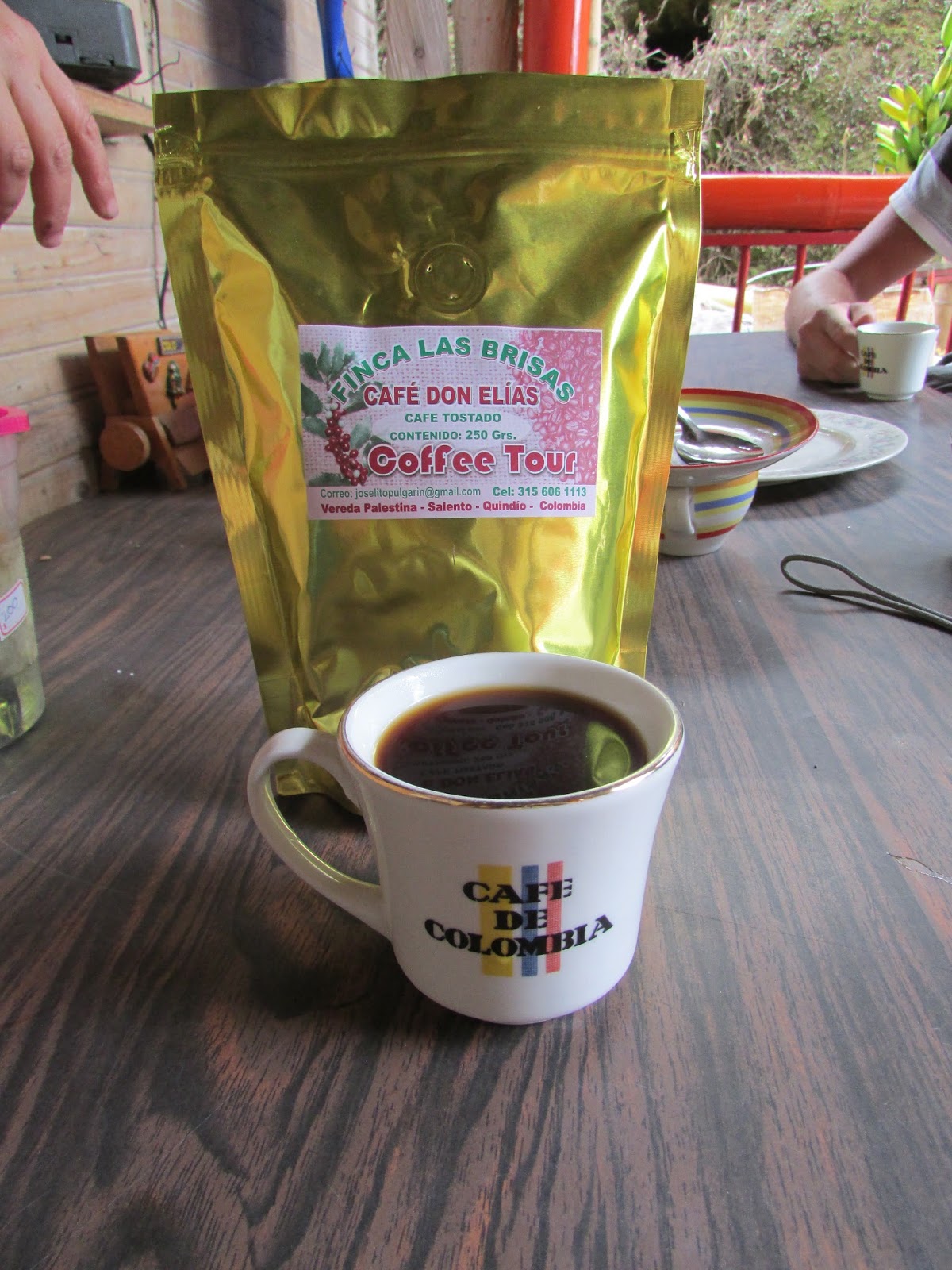
Before leaving Salento I made sure to visit a coffee Finca (/estate). I visited the Don Elias Finca which was a steep 4 km decent out of Salento. Although I had visited la Florida Finca with Trocaire when I was in Guatemala it was interesting to see this small family run organic coffee finca go through the coffee making process from start to finish. They grew two types of coffee beans on the finca, Arabica and Colombia. On the 4 hectares there were about 10,000 coffee trees which usually produced between 4-5,000 kg of coffee depending on the weather conditions. Half of this they sold to tourists who did the coffee tour and the other half was sold as the dried beans to a local co-operative.  

It all begins as a flower
The flowers die off and along come the tiny beans
They turn into bigger beans
Then they turn into bananas.. no hold on, that's a different plant.
Putting me to work to pick some beans
Freshly picked coffee beans
The picked beans are initially put through this machine which takes off the first skin
The skin or husk of the coffee bean
The husks in one hand, the inner bean in the other hand
The beans are then laid out to dry, about 7 days here if it is sunny and up to a few weeks if it is rainy.
Once the beans have dried out they are put in this large ceramic bowl to roast slowly
Here's some roasted ones we made earlier
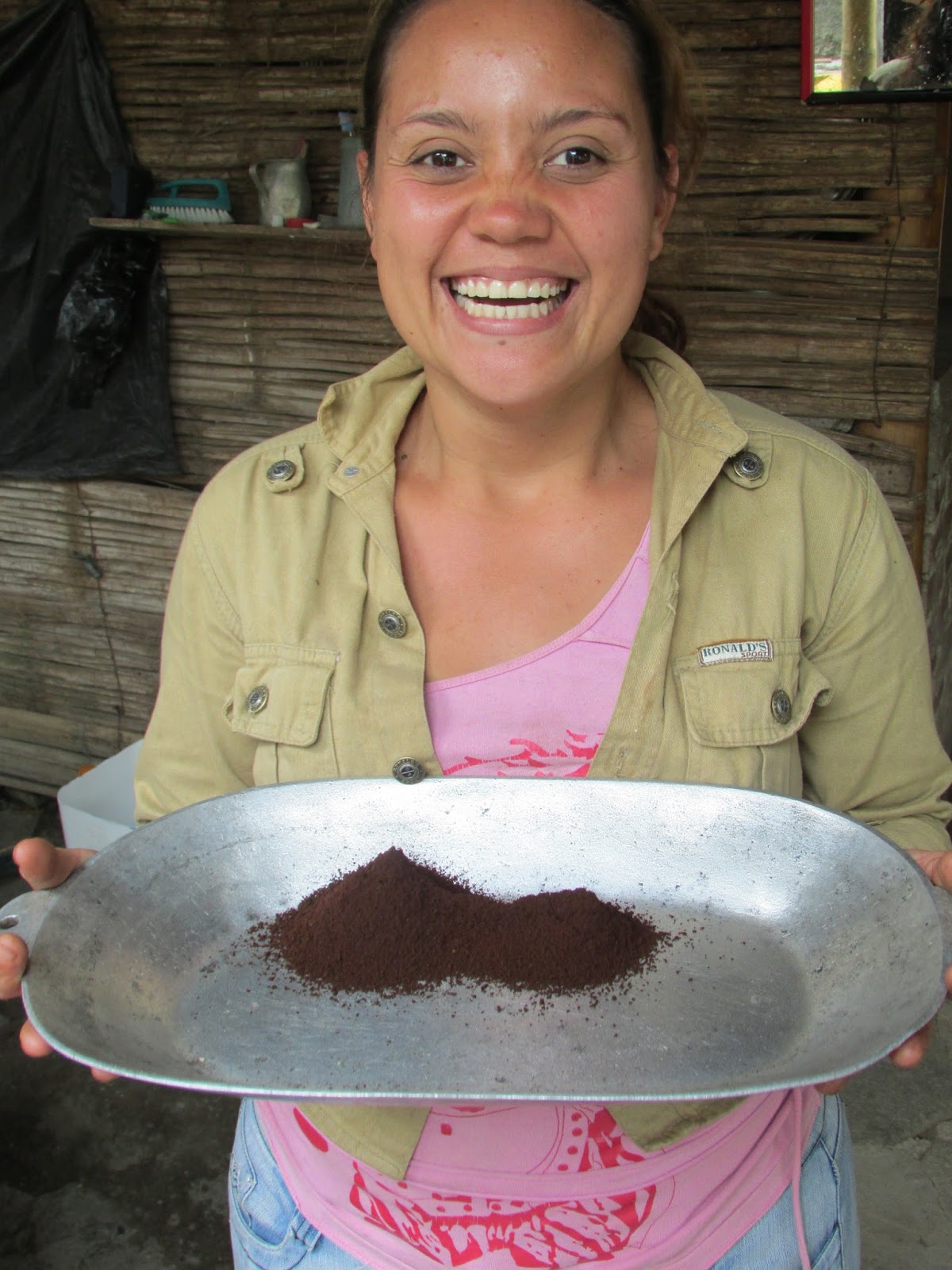
You're probably pretty familiar with the rest of the process, the roasted beans are then ground down..
Somebody likes their coffee
Then you add hot water and drink it being careful not to burn yourself... and that's where your cup of coffee comes from.
Laura, a German backpacker who checked into the hostel at the same time as me had decided that she wanted to give the cycling a go and so was going to join me on the roughly 200km cycle to Cali. It can be enough of a struggle on a touring bike specifically designed to carry all my bags and with a great gearing ratio but to cycle the route on a rented mountain bike carrying a heavily laden backpack is literally a backbreaking effort.

Laura, myself and Gonzalo who we met on the road out of Salento. He brought us along a nice flat dirt road with no traffic the first 12 km into the town of Armenia.
Menu del dia, didn't even have to pay extra for the hens foot.
Mmmmm.... Mingin'
I was highly impressed with Laura’s work and she didn’t complain once! Don’t think I would have managed! We were lucky enough to break up the journey when we stayed in Tulua with Carlos and his lovely family. I met Carlos through “WarmShowers.org” the website where cyclists look after other touring cyclist by providing them with a warm shower and a bed if you are lucky. This was the first time that I had used WarmShowers in Colombia and it was fantastic meeting Carlos and his family who made Laura and I feel very much at home. Carlos invited us out that evening to give us a tour of his home town and for an ice-cream with his friends. Also being a keen cyclist himself Carlos cycled the first 30 km with us the next day in the Cali direction and gave us some handy tips for side roads to avoid the heavy traffic into the busy metropolis of Cali. Thanks Carlos! By about 4 o’clock that afternoon Laura and I had managed to weave our way into central Cali.

Carlos Snr., Carlos and Laura as we get ready to hit the road for the day
Carlos and Laura


Laura and I bid farewell to Carlos as we continue towards Cali